The process by which BREEDPLAN compares animals running in different herds and in different environments can be broken down into two main steps:
- The performance recorded for an animal is directly compared with the performance of other animals that have had an equal opportunity to perform (ie. animals within their contemporary group).
- BREEDPLAN uses genetic linkage to compare animals across the different contemporary groups both within the herd, across herds & across countries.
Comparison within Contemporary Groups
BREEDPLAN analyses cattle in contemporary groups to take out the influence of as many of the non-genetic effects as possible (eg. feeding, years, seasons). The underlying principle is that only animals that have had an equal opportunity to perform are directly compared together within each contemporary group.
To read more about how contemporary groups are formed, click here.
Comparison between Contemporary Groups
Once BREEDPLAN has formed contemporary groups of similar animals, each contemporary group is then compared through the use of genetic linkage.
Genetic linkage can generally be described as “common animals”. That is, for BREEDPLAN to compare animals from different environments, herds must have some performance recorded progeny from common animals (typically common sires) so that the performance recorded animals in each herd are genetically related.
As an example of genetic linkage, consider a situation where 3 different contemporary groups of calves (either on the same property or different properties) are compared. There are environmental differences between the Groups - Contemporary Group 1 has relatively poor nutrition, Contemporary Group 3 average and Contemporary Group 2 relatively good.
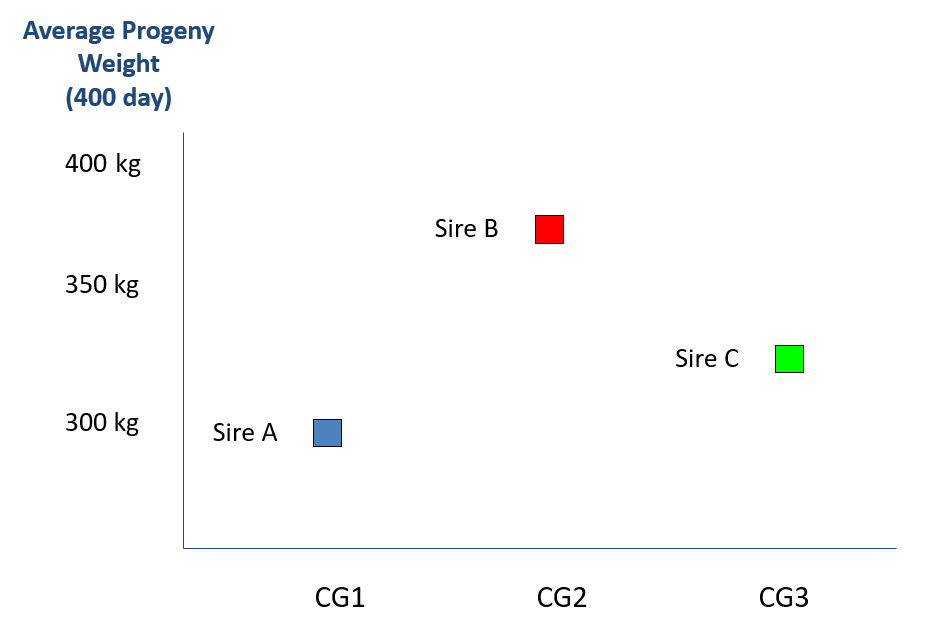
In this example, all of the progeny in each group are by different sires. Sire A is the sire of the progeny in Group 1, Sire B is the sire of the Group 2 progeny and Sire C is the sire of the progeny in Group 3. Under such conditions, it is impossible to make valid comparisons about the relative performance of the animals in the different contemporary groups, as there are no “links” between the groups and the groups have been running under different conditions.
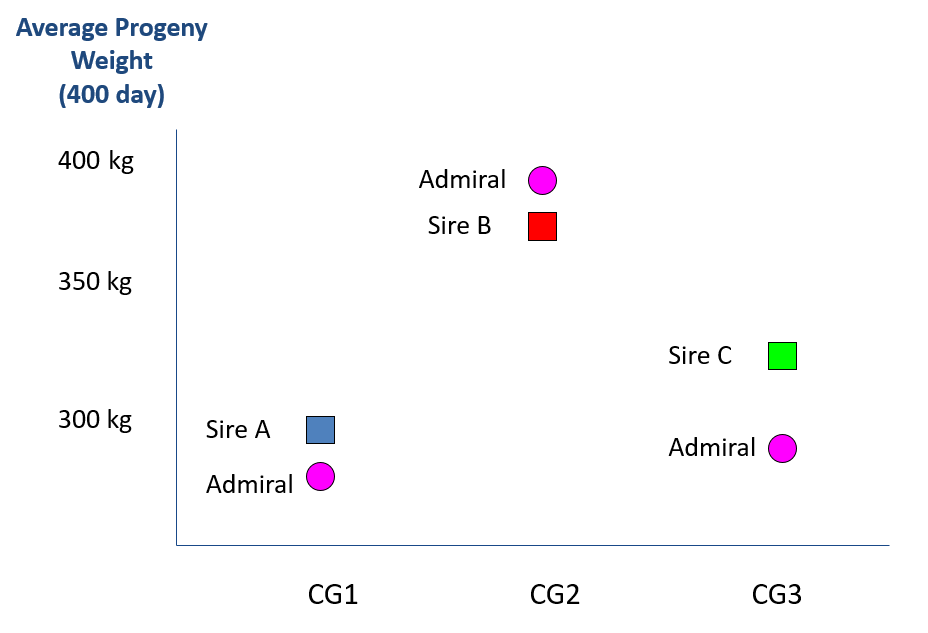
If however, progeny from a common link sire existed in each contemporary group (for example, an AI sire) then it becomes possible to compare the progeny of the different sires represented in each group. This is illustrated in the second graph where Admiral is the link (or common) sire.
The progeny of the link sire (Admiral) have average adjusted 400-Day weights of 290 kg, 390 kg and 300 kg in their respective contemporary groups. In comparison, the average adjusted 400-Day weights of the progeny of the other sires are: Sire A: 300 kg, Sire B: 380 kg and Sire C: 320 kg. For the purposes of this example, we assume that all sires are joined to cows of equal merit.
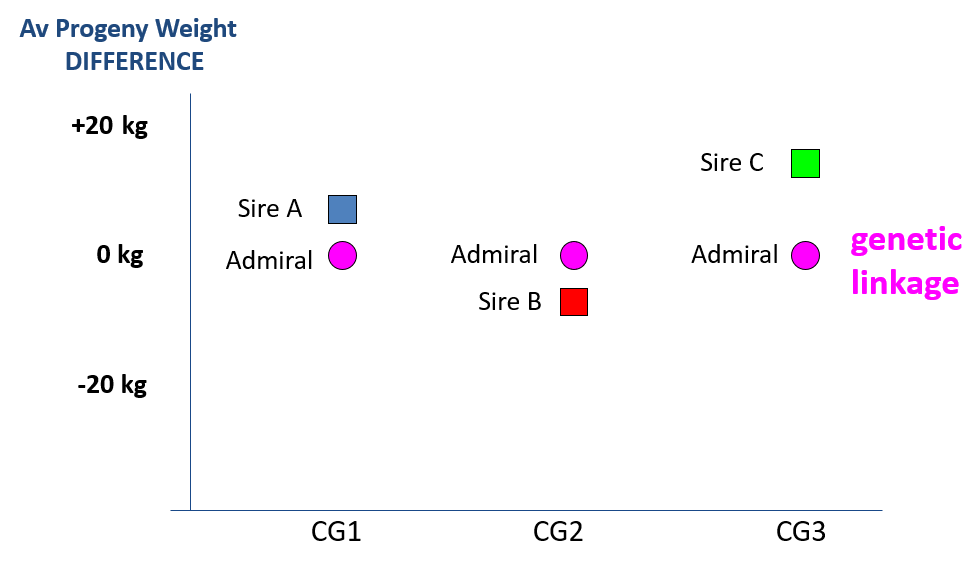
When compared to the link sire Admiral, Sire A tested in Contemporary Group 1 is superior to Sire B from Group 2. Sire C from Group 3 has the highest average 400 day weight performance.
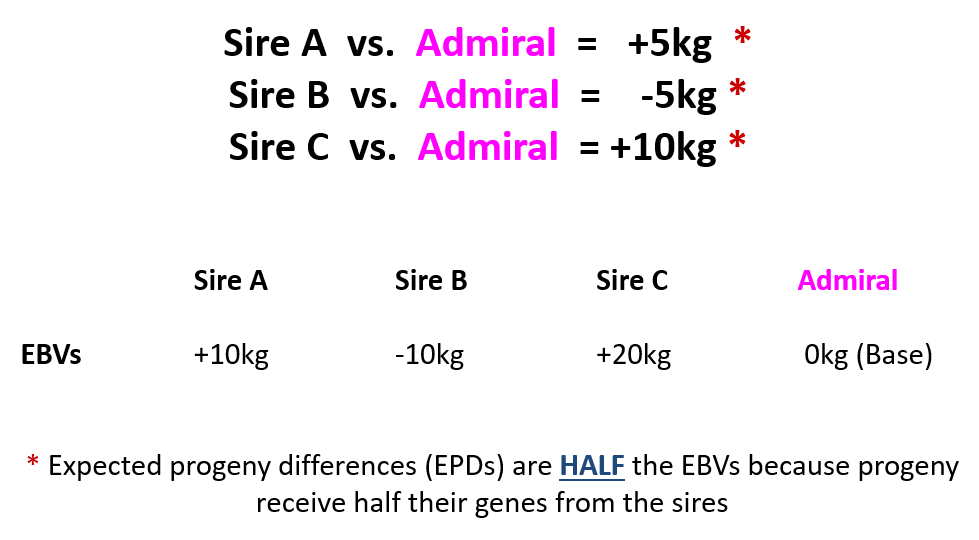
Assuming large progeny numbers (100+) for each sire, the sire EBVs will approach twice the progeny differences. This is because the progeny only receive half of their genes from their respective sires. The other half of their genes comes from the dam.
The EBVs assume that Admiral has a base 0 EBV, that reasonable numbers of progeny were measured and that the cows are of equal performance. Adjustments are made if cows are known to differ in BREEDPLAN.
If the progeny numbers are not large, the sire EBVs will be less than double the progeny differences, as BREEDPLAN makes conservative predictions. The scaling factor depends on the number of progeny of home sire and link sire and the heritability of the trait in question.