Charolais Single-Step BREEDPLAN Incorporates Southern Multi Breed project data
SMB data included from December 2025
Dec 2025Summary
- From December 2025, the Charolais Single-Step BREEDPLAN analysis will include data from the Southern Multi Breed project.
- Data on over 500 Charolais recorded in the project will be added to the reference population.
- This data includes growth, fertility and carcase traits, as well as genotypes.
- Charolais breeders can expect some movement in EBVs, associated EBV accuracies and selection indexes.
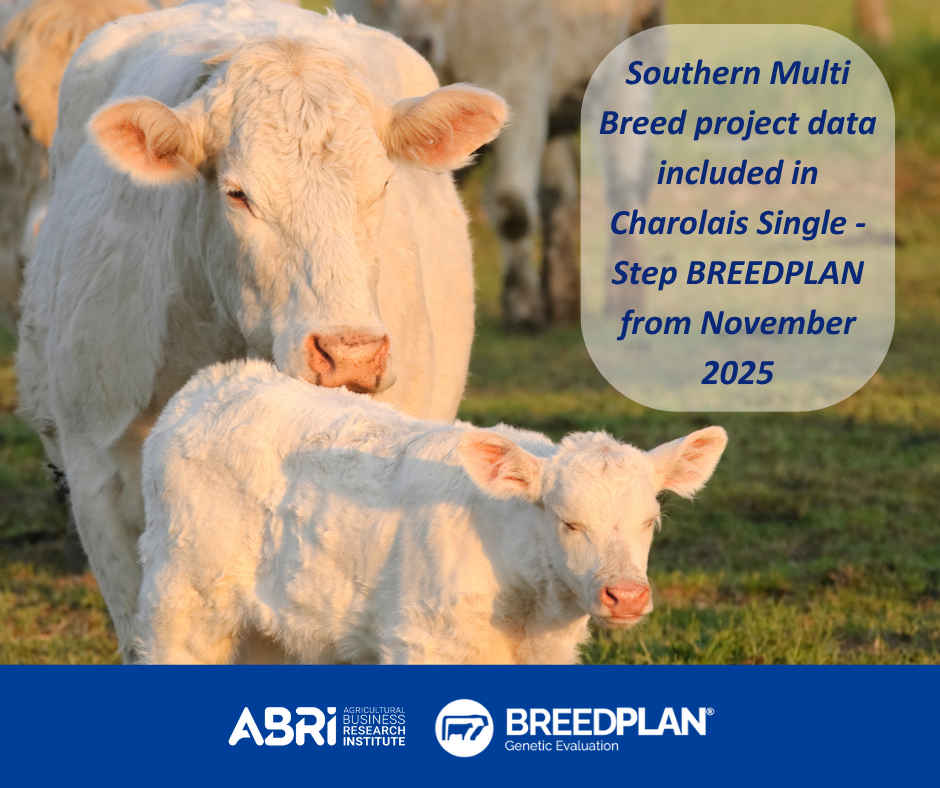
For the first time, data collected from Charolais cattle within the Southern Multi Breed (SMB) project has been included in the Charolais Single-Step BREEDPLAN analysis conducted for Charolais Society of Australia and the Charolais Breeders New Zealand Inc. This data was first included in the December 2025 Charolais Single-Step BREEDPLAN evaluation. The addition of this dataset will improve the predictive ability of EBVs across a wide range of traits, particularly those that are less commonly recorded within seedstock herds.
The Southern Multi Breed Project
The SMB project was established in 2019 as a collaborative initiative between NSW Department of Primary Industries and Regional Development (NSW DPIRD), the University of New England (UNE), and Meat & Livestock Australia (MLA). Its aim is to generate large, high-quality datasets across several beef breeds, strengthening reference populations and providing the information required for future development of multi-breed EBVs.
The project involved Charolais, Angus, Hereford, Shorthorn and Wagyu cattle, with Brahman also included to provide direct linkage to the Repronomics project in northern Australia. By running animals head-to-head across research herds, the project enabled direct comparisons between breeds for a wide range of BREEDPLAN traits, particularly those difficult or expensive to measure at scale.
The SMB herds are located at NSW DPIRD research sites including Grafton, Trangie, Glen Innes, Yanco, and the Elizabeth Macarthur Agricultural Institute at Menangle. Across five calf drops (2020–2024), animals were recorded, genotyped, and assessed for growth, fertility, efficiency, and carcase traits.
Importantly, the SMB project is not producing multi-breed EBVs itself. Instead, it provides the necessary head-to-head comparisons across breeds that will underpin the development of multi-breed EBVs in the future.
What Data Has Been Collected?
Animals in the SMB project have been comprehensively recorded for traits that are economically important but often difficult to collect in seedstock herds. These include:
- 200, 400 and 600 day weights – assessing growth rates.
- Carcase data – abattoir measurements for yield and meat quality, providing direct observations for carcase EBVs.
- Net Feed Intake (NFI) – a critical efficiency trait rarely measured on-farm due to infrastructure costs.
- Joining and fertility records – underpinning reproductive measures.
- Genotypes – ensuring every animal has a DNA profile to build the Charolais reference population.
For Charolais, this dataset includes over 500 animals. These records will add to the existing Charolais reference population (animals with phenotypes and genotypes), which already includes data collected directly on-farm by Charolais breeders. With many thousands of animals with genotypes already included in the Charolais Single-Step BREEDPLAN evaluation, the SMB contribution does not represent a huge jump in scale, but it does add depth in traits where information has been limited.
What This Means for Charolais Breeders
The inclusion of SMB Charolais data strengthens the foundation of Single-Step BREEDPLAN by broadening the Charolais reference population. For animals that may have genotypes but limited performance records, the expanded dataset improves the accuracy of predictions for genetic merit.
Of particular value are the traits that are costly or difficult to measure in seedstock herds, such as carcase yield and meat quality. The SMB dataset provides information for these traits at a scale not usually possible for breeders, improving EBV accuracy and providing more reliable selection tools.
Importantly, while Days to Calving and Net Feed Intake EBVs are not currently included in the Charolais Single-Step BREEDPLAN analysis, the collection of data for these traits will provide useful information that may allow these traits to be included in the evaluation in the future.
With the incorporation of the SMB dataset in the December 2025 Charolais Single-Step BREEDPLAN analysis, Charolais breeders can expect to see some shifts in EBVs and associated EBV accuracies. These movements are not errors but reflect the integration of new, high-quality data. In most cases, EBV accuracies will increase, particularly for traits that have been less well-recorded historically.
The improvements will also flow through to Charolais Selection Indexes. Because indexes combine multiple EBVs, any gain in EBV accuracy strengthens the reliability of the index and supports more confident selection decisions.
Test Analyses Already Conducted
To prepare for implementation, staff at ABRI and the Animal Genetics & Breeding Unit (AGBU) have already conducted test analyses with the SMB Charolais data. These confirmed the evaluation process runs smoothly and that the inclusion of SMB records delivers the expected benefits. This testing provides assurance that the December 2025 release has been carefully managed and that any changes seen in EBVs or indexes reflect genuine improvements in the dataset rather than technical artefacts.
Looking Ahead
The inclusion of SMB Charolais data into BREEDPLAN marks a significant milestone. It demonstrates the value of collaborative, large-scale research projects and highlights the willingness of industry to invest in the future of genetic evaluation.
While the dataset is modest compared to the existing number of Charolais genotypes, its value lies in the new traits it captures and the robustness it brings to genomic evaluation. Over time, these contributions will allow breeders to select with greater confidence for traits that impact profitability, efficiency, and market performance.