Selection indexes assist beef producers to make selection decisions that take into account the relevant growth, carcase, fertility and efficiency attributes of each animal to identify candidates whose progeny will be the most profitable for a particular commercial enterprise. Selection indexes provide an overall indication of an animal’s genetic value for profit in a specific production system/target market and are calculated based on weightings placed on individual traits that are deemed to be important for that production system.
The weightings are calculated using BreedObject software that analyses all sources of costs and income for the production system represented by each selection index. As such, selection indexes account for both sides of the profit equation and reflect the short and long term profit possible through selection of superior genetics. For example, short term profit can be generated by a bull through the sale of his progeny, and the longer term profit generated by his daughters in a self-replacing cow herd.
Best Practice Guide to Animal Selection Using the Performance Herds Australia Selection Index
Incorporating selection index information into breeding decisions takes the hard work out of trying to decide how much emphasis you need to put on individual EBVs when determining which animals you want to retain in your herd or purchase. The recommended strategy for selecting animals is to complete the following steps:
- Identify the selection index of most relevance to your or your client’s breeding objectives. This decision should be aided by the index descriptions at the end of this document.
- Rank animals on the chosen selection index. This can be done via the web search facility available for the breed.
- Consider the individual BREEDPLAN EBVs of importance. All breed level selection indexes are designed for the average of the production system specified in their description. This means that individual farm environments and management choices may require that their own thresholds are applied. For example, if looking for a bull to use over heifers, particular attention should be paid to Calving Ease and Birth Weight EBVs.
- Consider other traits of importance. Structure, fertility (e.g. BULLCHECKTM), temperament, genetic conditions and pedigree are all important additional considerations.
Further information is available in the A BREEDPLAN Guide to Animal Selection tip sheet that can be found in the Help Centre on the BREEDPLAN website.
Available Performance Herds Australia Selection Indexes
Performance Herds Australia currently reports one selection index. This is the:
- MSA-B2 Index
Each selection index is reported in units of net profitability per cow mated ($), and relates to a commercial herd using Shorthorn bulls targeting the following specifications:
MSA-B2 Index
- Self-replacing commercial herd targeting either the heavy domestic MSA or Japanese B2 export markets.
- Heifers are retained so maternal traits are important.
- Progeny are pasture grown and grain finished (80 to 120 days).
- Steers target 620 kg live weight (340 kg HSCW) at 19 months of age, while heifers target 540 kg live weight (290 kg HSCW) at 18 months of age.
- Significant premium for marbling.
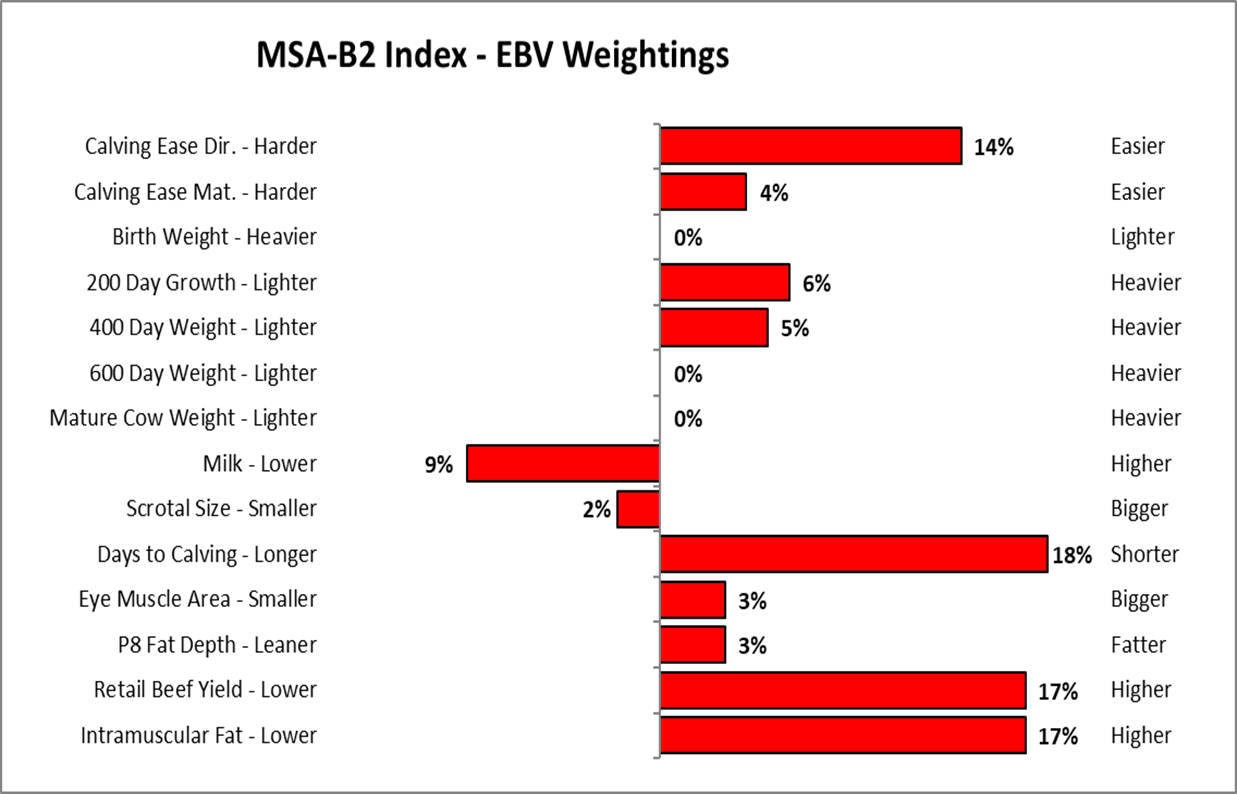
More detail on the trait and EBV emphasis for the selection index described above is available in the Performance Herds Australia Selection Index: Technical Specifications tip sheet that can be found in the Help Centre on the BREEDPLAN website.
If you have any further queries regarding the Performance Herds Australia Selection Indexes, please do not hesitate to contact staff at your BREEDPLAN processing centre.
